

Let Me Be Strait With You
Operation Epic Fury's Success Won’t Reopen Strait of Hormuz. It shouldn't.

This Substack is changing… Here’s Why.
Many of you may not know this: I’m an Air Force intelligence officer.
My job (particularly when I was stationed in Korea) was to understand how information is weaponized, how narratives are shaped, and how the gap between what people are told and what is actually happening gets exploited. I’ve watched that gap widen in real time — in culture, in media, and in the fraying of Western civilization’s classical liberal values.
I like productivity and self-help. But I won’t keep writing about morning routines while the world seems to be crumbling around us.
Watchtower Intel is a more honest version of this work. It’s where almost a decade of intelligence experience meets internet-nerd’s cultural analysis — where I take my passion for the lost art of reason and rhetoric, and point it at the things that actually matter — the arena of ideas.
As Master Samwise said:
“There’s good in this world, Mr. Frodo, and it’s worth fighting for.”
Welcome to the Watchtower.

There is a particular kind of commentary that has taken off this week. It goes something like this: The Strait of Hormuz is still closed. Tanker traffic has collapsed. Oil prices are spiking. Therefore, the operation has failed.
This conflates two entirely separate problems and uses the confusion to manufacture a verdict that the evidence doesn’t support. I’m hoping to show the distinction well enough that you can see the sleight of hand.
Let’s start with the ground truth… Water truth?
Some Strait Talk
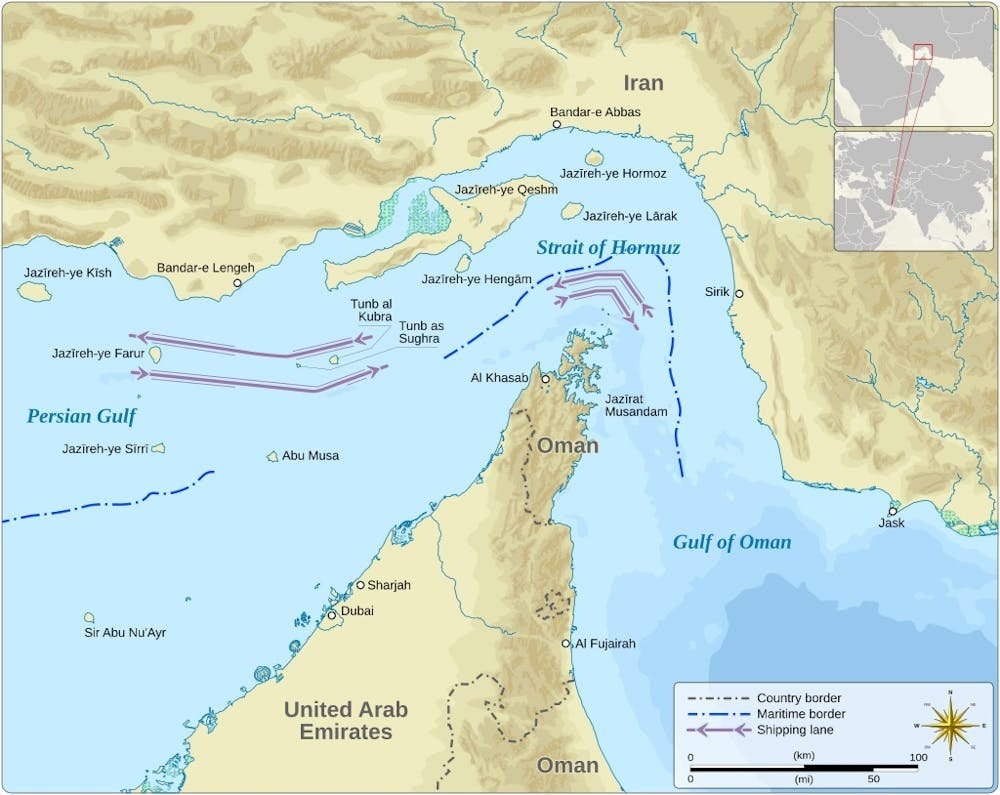
The Strait at its narrowest point is roughly 30 miles wide. That sounds like room to maneuver. It isn’t — because the 30 miles is almost entirely irrelevant. The International Maritime Organization has recognized a Traffic Separation Scheme that consists of two two-mile-wide shipping lanes: one for incoming traffic, one for outgoing. (The Strauss Center) A two-mile, 2-lane Oil Tanker highway.
Read that again slowly.
You have 35 miles of water. The usable highway a few miles wide with little to no buffer. The entire global oil transit corridor — more than 20 percent of global oil and liquefied natural gas exports, more than 30,000 tankers per year (Encyclopedia Britannica) — threads through this tiny channel of water.
Think of it this way: if you ran the new Air Force PT test, you would reach the other side. That is the margin of error inside which supertankers carrying a million barrels of crude oil are navigating, in both directions, every single day.
And Iran’s coastline — along with the military islands it has controlled since the 1970s — sits directly to the north of this tanker/fish-in-barrel situation.
What Epic Fury Actually Set Out to Do
The stated objectives of Operation Epic Fury are: destroy Iran’s ballistic missile arsenal and production capacity, annihilate its navy, sever support for terrorist proxies, and guarantee Iran never acquires a nuclear weapon. (The White House)
Those are defined military objectives with measurable outcomes. And the results against those specific target sets have been significant. Estimates from the U.S. Department of War suggest an 86 percent drop in Iran’s missile salvos and a 73 percent decrease in its drone-warfare activity since the beginning of the operation. (Hudson Institute) The objective, per U.S. officials, was to neutralize Iran’s ability to totally close the Strait of Hormuz by destroying major surface units and shore-based enablers. (Defense-Update)
Iran’s exquisite capabilities — warships, ballistic missile transporter-erector-launchers, drone program, the manufacturing infrastructure that feeds all of it — have been systematically degraded.
So why is the Strait still functionally closed?
Here is the strategic problem the naysayers don’t want to engage with honestly: threatening a two-mile waterway lane does not require conventional military capabilities.
It requires uncertainty.
Between March 7 and March 11, only 10 commercial vessel crossings were recorded, compared to a typical daily average of 70 to 80. (Windward) That collapse in traffic was not caused by Iranian frigates or anti-ship ballistic missile barrages. It was caused by the insurance market’s rational response to a threat environment that cannot yet be fully cleared — unmanned surface vehicles, the residual asymmetric capabilities that survive even a comprehensive air campaign against conventional forces.
A supertanker captain doesn’t need to be hit by a fast attack craft. The Iranian regime just needs him to be uncertain. His insurance underwriter just needs the possibility of danger.
This is the distinction that matters: Epic Fury’s objectives were to degrade Iran’s ability to project conventional military power. They were not, and were never stated to be, a guarantee of total maritime security in a 2-mile chokepoint that a radical, fundamentalist, theocratic regime has always weaponized.
Confusing those two things produces a false verdict. Epic Fury didn’t fail to do what it said it would do. It has accomplished much of what it set out to accomplish.
Some of you have been here since the Star Wars Report days and through the Full Focus era. I don't take it lightly. What I can tell you is this: It’s still me. I believe how you see the world matters. I hope you'll stick around.
MTFBWY
-Riley
Doesn't the causal chain run the other way? The White House chose escalation against a state whose almost entire deterrent leverage is geographic. The strait didn't close despite Epic Fury, it closed *because* of it. So, can we really grade the operation separately from its most predictable consequence? Further, if the strait is essentially already closed for free, what would Iran gain by shooting more? How do we distinguish "can't shoot" from "won't shoot" in the data? An 86% salvo drop is consistent with degraded capacity, but it's equally consistent with rational conservation by an adversary who's already winning the cost exchange.