

Divine Intervention(ism)
On Popes and Presidents.

Note: This piece examines reactions to recent Truth Social posts only to understand what they communicate to different audiences and why those audiences respond the way they do, not to debate the underlying politics or theology. The views expressed here are my own and do not represent the U.S. Air Force or the Department of War.
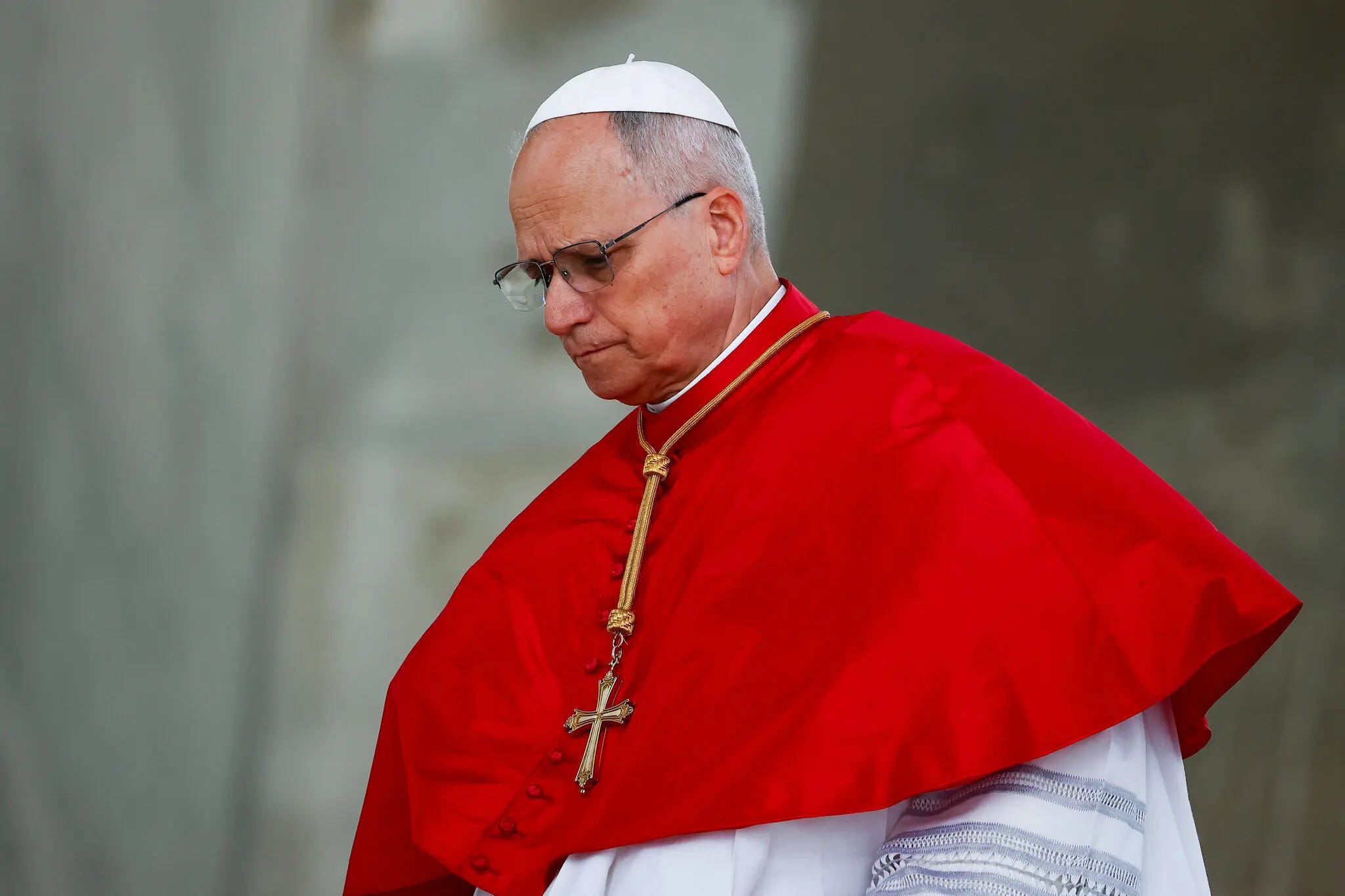
Last night, President Trump posted a lengthy critique of Pope Leo XIV on Truth Social, calling the first American-born pontiff “WEAK on Crime” and “terrible for Foreign Policy,” accusing him of catering to the radical left, and suggesting the Church only elected an American pope to manage the Trump presidency. Minutes later, he shared an AI-generated image depicting himself performing a miraculous healing, glowing hand extended over a bedridden man, an American flag, and eagles visible in the sky behind him.
Understanding the substance of the President’s frustration with the Pope requires some intellectual (and theological) curiosity. Pope Leo has publicly and repeatedly criticized the U.S.-Israel campaign against Iran, insisting that “Jesus is the king of peace, who rejects war, whom no one can use to justify war.”
The real story here is the varied reactions to the Truth Social posts. And to understand it, you have to read it not through the lens of culture war politics, but through the lens of signal. What do these posts transmit, to which audiences, and what does each audience do with it?
The Domestic Coalition Signal
For the MAGA base, the posts read as strength. The Pope positioned himself as a moral critic of U.S. military action; the President responded directly and publicly with irreverence and disdain for the Pontiff's remarks.
But that’s not the only audience inside the MAGA coalition, and the responses from within it were striking. Michael Knowles, one of the most prominently MAGA-aligned Catholic commentators in media, posted publicly that “it behooves the President both spiritually and politically to delete the picture, no matter the intent.” That drew 1.4 million views. He also reposted a detailed theological response explaining the Catholic doctrine of Papal Infallibility — specifically, the distinction between the Pope’s ex cathedra teaching authority (binding on the faithful) and his personal, non-authoritative opinions on temporal matters like war and foreign policy, which carry no doctrinal obligation. This POV gives MAGA Catholics a framework for rejecting the Pope’s politics without questioning the Church.
Riley Gaines, a conservative activist/collegiate swimmer, speaking from a broadly evangelical-adjacent POV, was direct: “a little humility would serve him well. God shall not be mocked.” She’s citing Galatians 6:7. Marjorie Taylor Greene, herself a former Trump ally, noted that the post went up “on Orthodox Easter” and that the pope “is rightly against Trump’s war in Iran.”
What is notable across all of these responses is what is absent: very few prominent conservative voices defended the image.
The Institutional Signal
The Western political tradition has challenged the idea of leaders who present themselves as more than men and begin to borrow the aura of the divine.
Meaning, the idea of limited government, the separation of spiritual and temporal authority, and the concept of a ruler accountable to something beyond himself are foundational to the political tradition going back to the conflict at Canossa in 1077 between Pope Gregory VII and Emperor Henry IV. These are the ideas that produced the American Republic.
The fact that the pushback from Knowles, Gaines, and others came publicly and on principle, from people who broadly support Trump, is not evidence of coalition collapse. It’s evidence of a cultural and political debate functioning as it should.
The Geopolitical Signal
This is where precision matters most, and where I want to be most careful.
The United States just concluded (For now) 38 days of major combat operations against a regime whose foundational governing principle is the fusion of divine authority and political power. The Islamic Republic of Iran does not merely claim political legitimacy; it claims theological legitimacy.
This piece is not drawing a moral equivalence between the administration and the Iranian theocracy. That comparison is both unfair and imprecise. (That won’t stop some pundits) To state what should be painfully obvious… The American Constitutional Republic and Iranian velayat-e faqih (Shia Islamic political doctrine) are not the same thing.
But the signal is about what a message does once it leaves the sender’s hands. Context matters. Secretary Hegseth invoked scripture when framing the Iran campaign. Pope Leo’s counter was a response to that framing. The AI image, posted in that context, does not exist in a vacuum. It lands in an information environment where adversaries are actively scanning for material that undercuts U.S. legitimacy and standing in the region.
The Throughline
The clash with the Vatican is not primarily a religious story. It is a stress test on a coalition that was held together, in significant part, by shared political opposition. The Iran war has been a clear fissure, a conflict where some coalition members have sincere reservations about the scope, cost, and objective. The AI image is another fissure.
From the Watchtower,
-Riley
Sources: Axios | Variety | Washington Post | Time | CNN | NPR | Daily Caller | The Daily Beast | Michael Knowles / X